Iran During Blackout
State Massacre Amid Crisis of Legitimacy

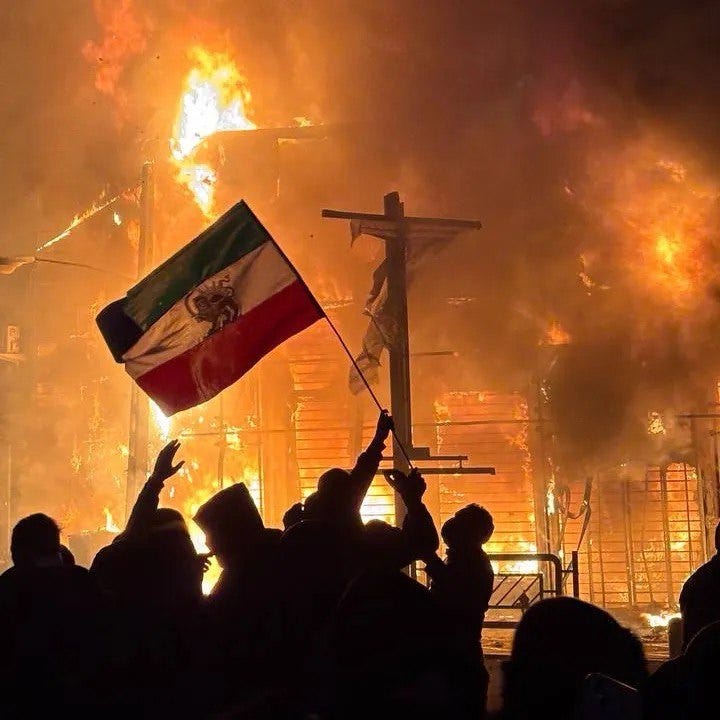
[ADDENDUM - January 25, 2026]
Updated Death Toll Estimate
Since publication, additional reports reveal the death toll from January 8-9 reached ~30,000 to 36,500+, not the 12,000-20,000 originally cited. The original analysis remains valid, this reflects more complete intelligence now available.
Western academic discourse has historically underrepresented and mischaracterized Iran, resulting in a substantial knowledge gap concerning the country’s political dynamics, social movements, and the lived experiences of its population. This gap has significant consequences, as it obscures the agency, demands, and perspectives of Iranian communities both domestically and in the diaspora, and allows misinformation to circulate unchallenged within policy and intellectual arenas. This document seeks to address this deficiency by compiling and presenting the most reliable information available about ongoing events in Iran, drawing on reporting from credible international news organizations, human rights monitors, and other verified sources. Despite the comprehensive internet and cellular blackouts imposed by the Islamic Republic and the dissemination of misinformation by state actors, this document prioritizes documented evidence, differentiates between verified facts and constructed narratives that draw attention but conceal the truth, and provides readers with resources to assess information independently.
This document contains three sections: (1) “What is Happening in Iran” elaborates the immediate humanitarian crisis (1.1), the documented scale and methods of the Islamic Regime’s response to peaceful protests (1.2); (2) and the historical trajectory of protest movements leading to the current moment; (3) “Islamic Regime’s Legitimacy Crisis” examines economic, ideological, and political indicators; (4) “Patterns of Western Media Coverage and the Hesitation of the West” examines the media coverage bias and the playful reporting that distracts the focus away from the human crisis unfolding in front of us.
Given the urgency of the situation, we aim to improve and add to this document on a rolling basis. Hence, your feedback and comments (in addition to your support, of course) will be extremely helpful and greatly appreciated. Should you have any questions, concerns, or would like to help, please email us at UnityforIranNYC@gmail.com.
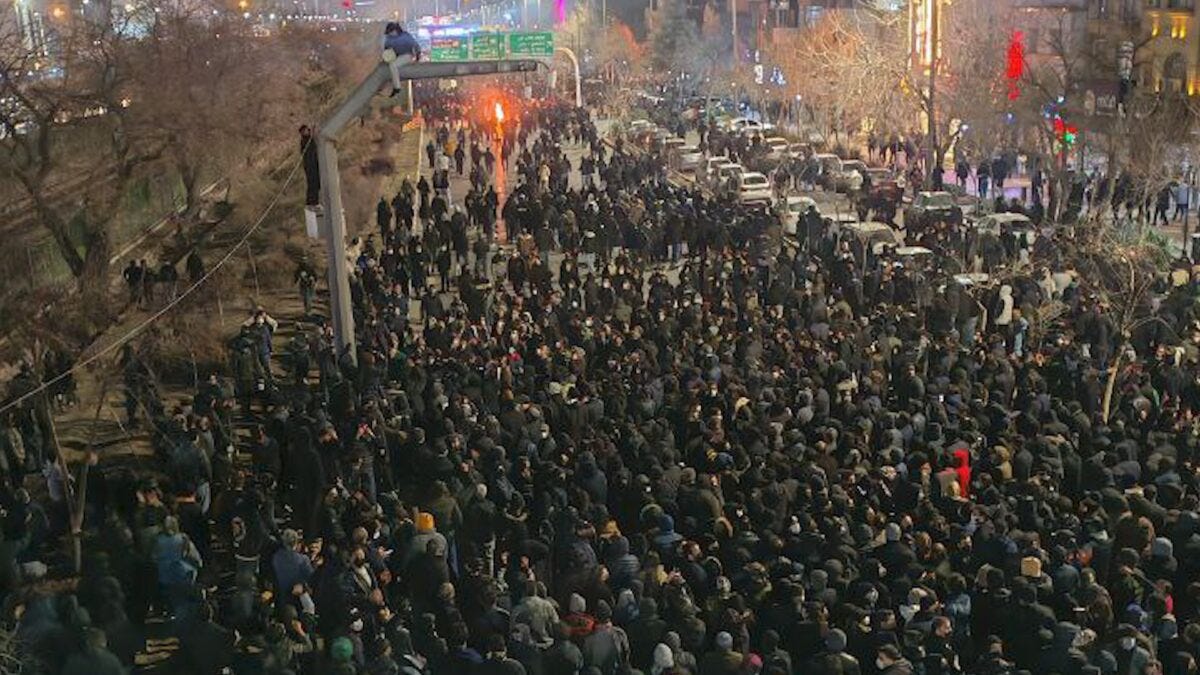
1. WHAT IS HAPPENING IN IRAN
1.1 What has been taking place during the complete blackout in Iran
THE IMMEDIATE CRISIS: December 28, 2025 – Present
On Dec 28, 2025, Bazaar shopkeepers in Tehran began to strike and protest the historic collapse of the Iranian currency (Rial).1 The protests and strikes very soon spread to all 31 provinces, 180+ cities, and 512 other locations. On December 31st, the strikes spread to Isfahan, Mashhad, Shiraz, Tabriz, Karaj, and Ahvaz. And on January 8th and 9th, strikes reached a national scale. Reposts show work stoppages or closures in 30-50 cities nationwide.2
On January 8th and 9th, an estimated 5 million Iranians responded to Reza Pahlavi’s call and took to the streets across 31 provinces (180+ cities and 512 locations).3 Their demand is clear: the Islamic regime must go. In response, the Islamic regime (IR) and the Revolutionary Guard (IRGC) shut down the internet and the cell lines of the entire country.4 Iran entered a complete blackout that continues to this day (last updated January 25th, 2026).5 The blackout was intended to prevent Iranians from communicating the atrocities committed by the IR with the outside world and to buy time to cover up the evidence of mass killings. However, through videos, messages, and images received via Starlink, and according to classified IRGC documents reviewed by Iran International's Editorial Board,6 corroborated by two senior Ministry of Health officials who spoke to TIME,7 the death toll from January 8-9 reached approximately 30,000 to 36,500+. This represents a significant revision from initial estimates of 12,000-20,000 deaths reported on January 13.8
Although it is not currently possible to provide an exact number of casualties and arrests, the estimates were obtained through an information leak in the IRGC’s internal communication.9 Some analysts believe the estimates are conservative and that the toll is much higher.10 For reference, 30,000 is ten times more than the 3,000 killed in the September 11th attacks and is exceeding the 14,000 civilian deaths from Russia’s invasion of Ukraine. The massacre of 30,000–36,500+ civilians over the course of two days would constitute one of the deadliest episodes of mass civilian casualties in the post-World War II era.
1.2 What is IRGC, and what was the regime’s response
IRGC (Islamic Revolutionary Guard Corps) refers to Iran’s powerful parallel military organization, established to protect the 1979 Islamic Revolution. The IRGC operates alongside Iran’s conventional army and controls significant military, political, and economic sectors, with its elite Qods Force conducting foreign operations and supporting regional proxies like Hezbollah. It’s a key instrument of the Islamic Republic’s power, responsible for enforcing the regime’s ideology and projecting influence abroad. IRGC has been central to both domestic repression and regional security operations. The IRGC has used unlawful lethal force, torture, and mass arbitrary detention to crush protests.
The Regime’s Response to the Protests since December 28th 2025:
IRGC and Basij deployment on the streets.11
The Supreme Leader and prosecutors have characterized protests as “moharebeh” (waging war against God) or “efsad-fel-arz” (corruption on earth)—serious charges that carry the death penalty.
Direct orders from Khamenei authorizing live fire on unarmed demonstrators.12
Hospital raids to arrest injured protesters, prevent casualty documentation.13
Internet blackouts and total communications cutoffs a few hours after January 8th (1.5 million people were in the streets on January 8 in Tehran alone).
~30,000-36,500+ civilian deaths (multiple sources: Iran International,14 Times,15 activist medical networks)
18,000+ detentions, imminent mass trials and death penalty, threat of execution.16
Military-grade jamming against Starlink; door-to-door raids for satellite receivers = deliberate documentation prevention.17
Supreme Leader and state officials blame protest casualties on Trump.18
The state pressured families of dead protesters to pay for bullets.19
Methods and Evidence:
Rifles, machine gun fire, metal pellets, water cannons, tear gas, beatings, and knives.20
Hospitals are overwhelmed with gunshot wounds to the head and eyes.
Tehran doctor to TIME: six capital hospitals recorded at least 217 deaths by Jan 8, “most by live ammunition.”21


Leaked mortuary videos from Tehran’s Alghadir Hospital show rows of 250+ body bags overflowing, with swollen, bullet-riddled corpses—many with head/eye gunshot wounds from security snipers on rooftops—displayed for families amid the January 9 massacre.22 CCTV from western Tehran captures motionless bodies on bloodied streets after 20-second rooftop fusillades, while Kahrizak morgue footage reveals 120+ bags with birdshot pellets and gashes, including children.23 Hospital floors overflow with lifeless patients bleeding from live rounds and beatings, as witnesses describe commandos executing protesters point-blank in Rasht.24
2. How Did We Get Here?
Summary of the Key Developments:
2009 (The Green Movement): Emerged in protest against massive election fraud, but was met with the use of the regime’s force against the protesters; 112 civilians were killed25, and the leading figures, known as the reformists, were put on house arrest.26
December 2017–January 2018: Protests, triggered by economic grievances, rapidly spread across more than 20 provinces with explicit calls for regime change, resulting in at least 41 documented deaths and approximately 3,700 arrests.27
November 2019 (Bloody Aban Uprising): Regime’s definitive break with symbolic consent. Internet blackout and mass killings eliminated any remaining ambiguity about coexistence; communities recognized the Islamic Republic as an illegitimate state. About 1,500 people were killed during less than two weeks of unrest that started on Nov. 15. The number of voters for the presidential election after 2019 significantly dropped.28
September 2022 (Woman, Life, Freedom): Triggered by the murder of Mahsa (Jina) Amini, a 22-year-old girl beaten to death in morality police custody, centered on bodily autonomy and civil liberty. The event has had a strong and lasting effect on cultural transformation in families, schools, and social media. Estimates of 500 dead.29
Critical distinction: what began on December 28th, 2025 in the bazaar as a response to the collapse of the official currency of Iran, the rial, has rapidly unfolded into a nationwide uprising that cuts across gender, class, religiosity, and ethnicity, drawing in students, workers, small shopkeepers, and communities from Kurdistan to Baluchistan and Azerbaijan. The sheer geographic spread and persistence of protests in the face of brutal repression with security forces using live ammunition, mass arrests, torture, and public executions has turned this wave of dissent into an open contest over sovereignty rather than a limited episode of unrest. In practice, the regime’s willingness to kill on a mass scale to retain power has only deepened its crisis of legitimacy, exposing an ever-widening gap between state and society and revealing a population that increasingly experiences the Islamic Republic not as a flawed government to be reformed, but as a violent occupying power to be confronted. Except for the Green Movement, which was largely rooted in the urban middle class and focused on electoral reform, the subsequent uprisings—those of December 2017–January 2018 and Bloody November 2019—were led predominantly by working-class and lower-middle-class Iranians who directly challenged the regime’s legitimacy and the broader post-1979 political order. The current 2025–2026 uprising, in turn, has brought together participants from all segments of society, uniting diverse social groups in rejecting that order as incompatible with human dignity, economic survival, and national prosperity.
In 2009, Iranians demanded that the regime hold a legitimate election and that their votes be counted fair and square. The regime opened fire on civilians and showed no flexibility or sign of reform.30 The December 2017–January 2018 protests, triggered by economic grievances, rapidly spread across more than 20 provinces with explicit calls for regime change, resulting in at least 41 documented deaths and approximately 3,700 arrests. In November 2019, widespread protests erupted across Iran after fuel prices rose by up to 200%, sparking anger among working-class citizens. In a country with massive oil reserves. Iran has about 1.1% of the world’s population, yet the country holds roughly 10% of global oil reserves, 15% of natural gas reserves, and 7% of the world’s mineral resources.31 Demonstrations quickly spread from provincial cities to Tehran, turning political with calls for the fall of the Islamic Republic. Security forces clashed with protesters in over 100 locations as demonstrators shouted, “They live like kings, people get poorer.” Again, the regime showed no mercy nor reform.32 In 2022, the Iranian regime’s morality police arrested and brutally murdered 22-year-old Mahsa Amini for not wearing a "proper" hijab, with a video of her collapse going viral on social media and igniting protests. Millions took to the streets across all 31 provinces to defend human dignity, amplified by platforms like Instagram, Twitter, and Telegram for organizing and sharing footage despite regime censorship and suppression. The slogan “woman, life, freedom” echoed globally, earning international condemnation from human rights groups and Western nations for the regime's disproportionate violence, including live ammunition, tear gas, metal pellets, and beatings, which killed over 500 civilians, including dozens of children, while labeling protesters "rioters" facing maximum penalties.33
What is taking place in Iran during today’s blackout is an amalgamation of all movements of the past 47 years, with a realization that not only is the IR unreformable, but the entirety of the regime must be removed because of its ideological rigidity, criminal acts, and anti-Iranian nature. In the previous instances of Iranian uprisings—and consistently since the late 1990s with the election of Mohammad Khatami in 1997-the regime has used the narrative of internal reform to absorb anger, redirect protest energy into elections, distract oppositional movements, and restore the regime’s legitimacy without altering the actual centers of power. The true intention of the reforms has been to stabilize the situation in order for the regime to buy time, divide the opposition, and convert revolutionary demands into procedural hopes.
Today, the Iranian people view reforms as a “safety valve” for the regime to prevent an uprising. Iranian people rejected the regime’s factions during their major protest in 2018, 2019, and during “woman, life, freedom,” by chanting “reformists, hardliners, the game is over” showing us the public’s complete severance from the narrative of reform. The economy was the instigator of the new uprising but the demands have been well beyond the mere economic issues: people in Iran want regime change, as clearly demonstrated by the few slogans that we hear from the streets. While chants honoring Reza Shah (Ruhat Shad-"rest in peace," -Iran's king from 1925-1941 and grandfather of Reza Pahlavi) emerged during Bloody Aban, the current uprising is the first to explicitly and consistently articulate support for Reza Pahlavi's return as a unified demand.
“This year is the year of blood; Seyed Ali [Khamenei] will be overthrown.”
“Down with the dictator.”
“Javid Shah,” i.e., long live the king
“This is the last fight, Pahlavi will return.”34
“Freedom, freedom, freedom.”
“Death to Khamenei.”
“We fight, we die, we get Iran back.”
“Reza Shah, rest in peace.”
This unified rejection of reformism and embrace of revolutionary change is evident in four developments. First, according to The Group For Analyzing and Measuring Attitudes in IRAN (GAMAAN), only 15% percent of the eligible voters in Iran intended to participate in the 2024 election.35 Second, the slogans are limited to two central messages: the regime must change, and that there is an intended opposition leader. While protesters cannot formally vote on a successor due to government suppression, the complete absence of competing slogans or alternative leadership demands suggests a unified consensus: the regime must fall, and there is broad alignment around a specific opposition figure.36 Third, the widespread use of the pre-1979 Islamic revolution flag (i.e., the lion and sun flag) as a symbolic indicator that the people no longer side with the IR and do not recognise it as a legitimate state. Fourth, several reformist leaders have sided with IR and have labeled the protestors as rioters. Most notably, Mohhammad Khatami, the reformist president from 1997-2005—and once supported by those who today call for regime change—is now calling the protests “an Israeli and US conspiracy,” showing that the current protests have severed ways with these figures and have moved past the narratives of reform.37
3. Islamic Regime’s Legitimacy Crisis: Economic, Political, and Ideological
A. Economic Crisis:
52.6 % overall inflation ; 72 %+ food inflation. Positive changes in the market no longer help Iran’s economy.38
Currency at historic lows; oil revenues collapsed (sold to China at steep discounts).39
Power outages, water rationing in a resource-rich country.40
Unemployment is endemic; the data shows that Iran’s labor force participation rate has dropped to 40.8%; brain drain of professionals/technocrats. 30% percent of Iranians dream of emigrating, with 62% of those who leave never intending to return, marking a cultural and social catastrophe beyond mere economics.41
Pension system insolvency; systematic wealth extraction by elites, mostly IRGC.42
"Resistance economy" strategy proved disastrous under mismanagement and corruption.43
B. Political, Geopolitical, and Ideological Crisis:
Voter participation collapse: The sharp decline of election turnout signals public severance from IR’s values, narratives, and legitimacy of governance.44
Generational rupture: The under-30 population (nearly half of Iran’s 92 million population) generally rejects revolutionary rhetoric and seeks to “live freely”.45
National unity and secular discourse replaces islamist and reformist ideology: “Long live Iran” instead of “Death to America”; opposing IRGC’s foreign intervention and hostile regime policies toward the West.46
Regaining national identity: the reemergence of the pre-IR symbol, such as the Iranian flag (i.e., lion and sun flag).47
Regional intervention (Axis of Resistance) now seen as economically ruinous and strategically disastrous.48
Regional collapse: Israel’s June 2025 operations decimated Hamas/Hezbollah leadership; Israeli aircraft maintained uncontested airspace over Iran. Strategic humiliation combined with economic desperation shattered the regime’s credibility narrative entirely.49
4. Systematic patterns of bias in media portrayals of Iran’s uprising
Some news outlets like Al Jazeera-often critiqued for alignment with Qatari interests sympathetic to IRI-have framed Iran’s 2026 uprising using regime terminology such as “rioters” and “foreign-backed unrest,” echoing state official narratives while equivocating on documented security force violence. Rather than recognizing the movement as a revolutionary demand for regime change under the slogans “down with the dictator,” and “this is the last fight, Pahlavi will return,” they have reduced it to narrow, manageable, and merely economic grievances. However, this implicitly recasts a systemic political revolt as a limited social reform campaign. At the same time, media coverage frequently portrayed protests as “fatigue,” in decline, or dissipation, and helped to normalize the regime’s false claim that the uprising had failed or lost legitimacy.50 In some cases, reporting disproportionately focused on casualties among regime forces and security personnel, while minimizing or flattening the scale, intent, and political meaning of the mass killings of protesters.51 The cumulative effect was a depoliticized and containment-oriented narrative that aligned more closely with the regime’s interests than with the stated aims of the protesters themselves.
While the IR’s atrocities inside of Iran get no coverage, Al Jazeera and some other news outlets cover a wide range of analysis that seeks the IR’s narrative.52 Below are a few examples of framings that actively distract the public opinion from the massacre taking place inside Iran:
Article on Iran’s foreign minister (Jan 12):
Center Araghchi’s line: protests became “bloody” to give Trump an excuse; blames “terrorists.”53
Reporting on “Israel-linked network” and helping to shape a narrative kin to IR’s ideological agendas (Jan 15):
Frames external reporting on the massacre as driven by Israel/pro-Israel accounts, echoing regime claims that the uprising narrative is foreign manipulation.54
Framing the uprising as externally orchestrated US regime change operations that dismiss genuine Iranian agency.55
Portraying protests as exploited by Israel/US interests to delegitimize internal dissent.56
Ideologically critiquing the movement as insufficiently revolutionary and reactionary while ignoring mass casualties and demands for democracy and freedom.57
While the systematic killings and the humanitarian crisis continue in Iran, starting January 16th, Al Jazeera provides live updates on other world events. At the same time Their reports on Iran that take the front page follow a reductionist narrative, reducing the current revolution to economic grievances:
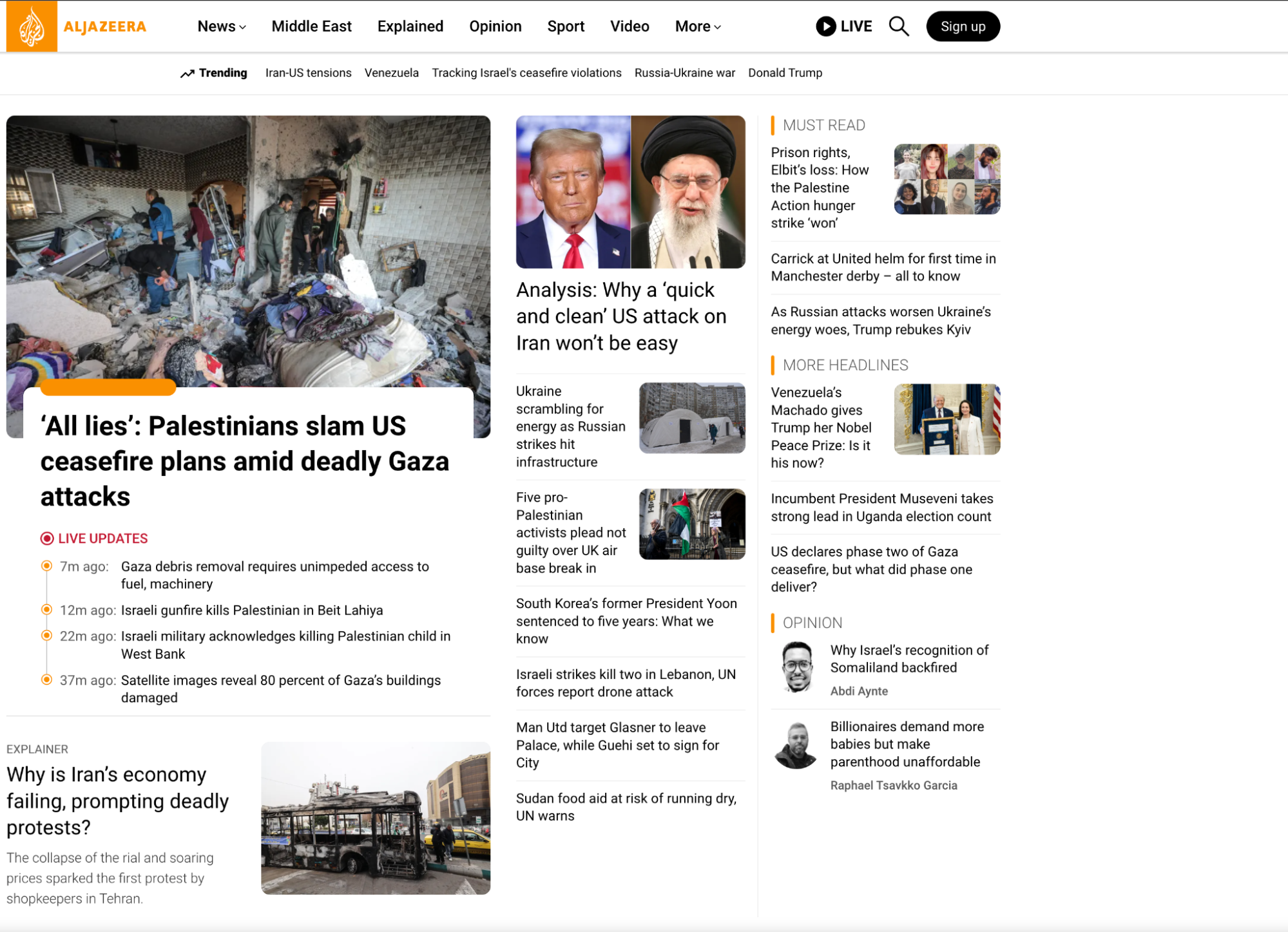
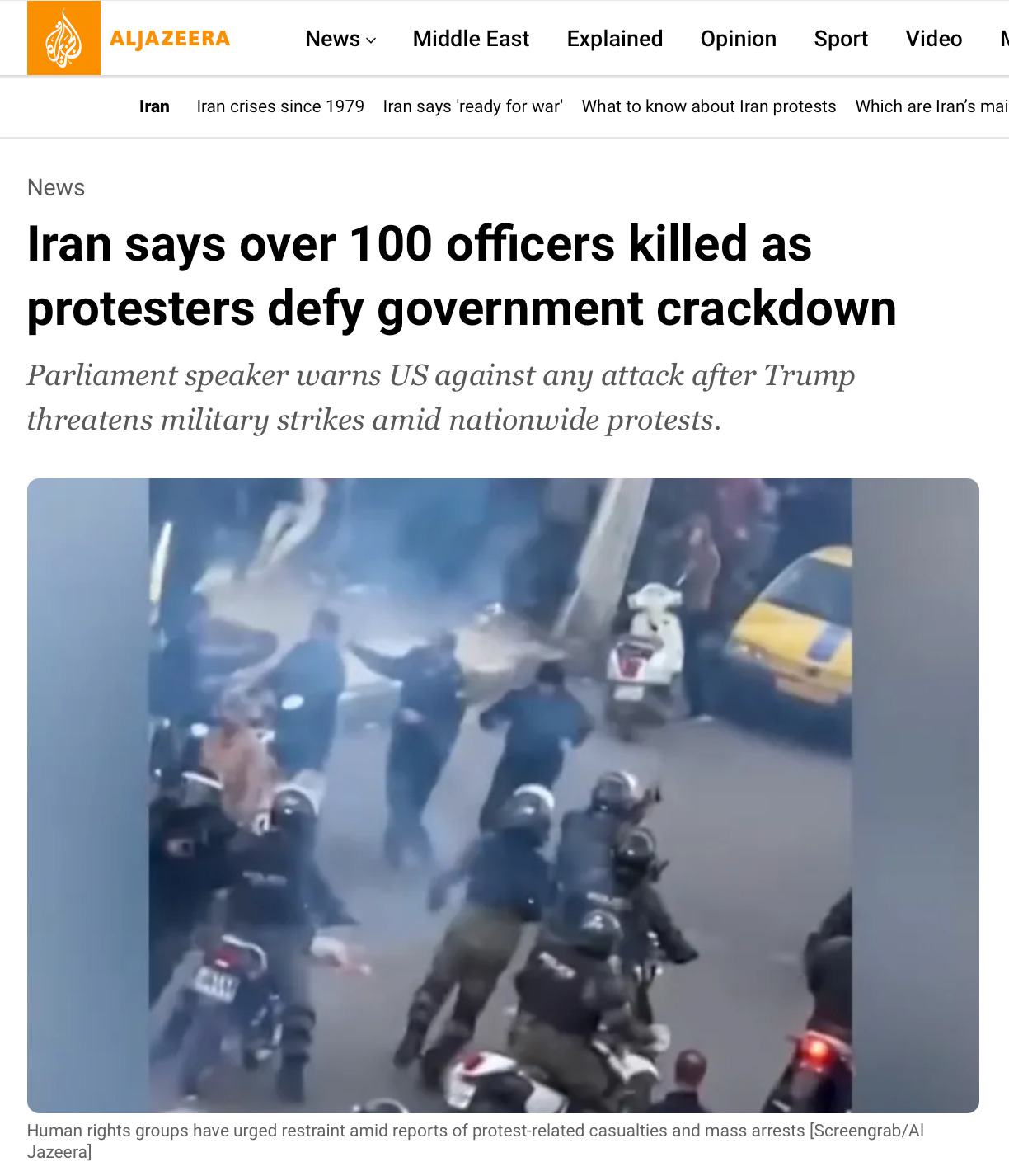
This headline highlights Tasnim’s claim of 109 security personnel killed, but does not foreground independently sourced protester death tolls.58
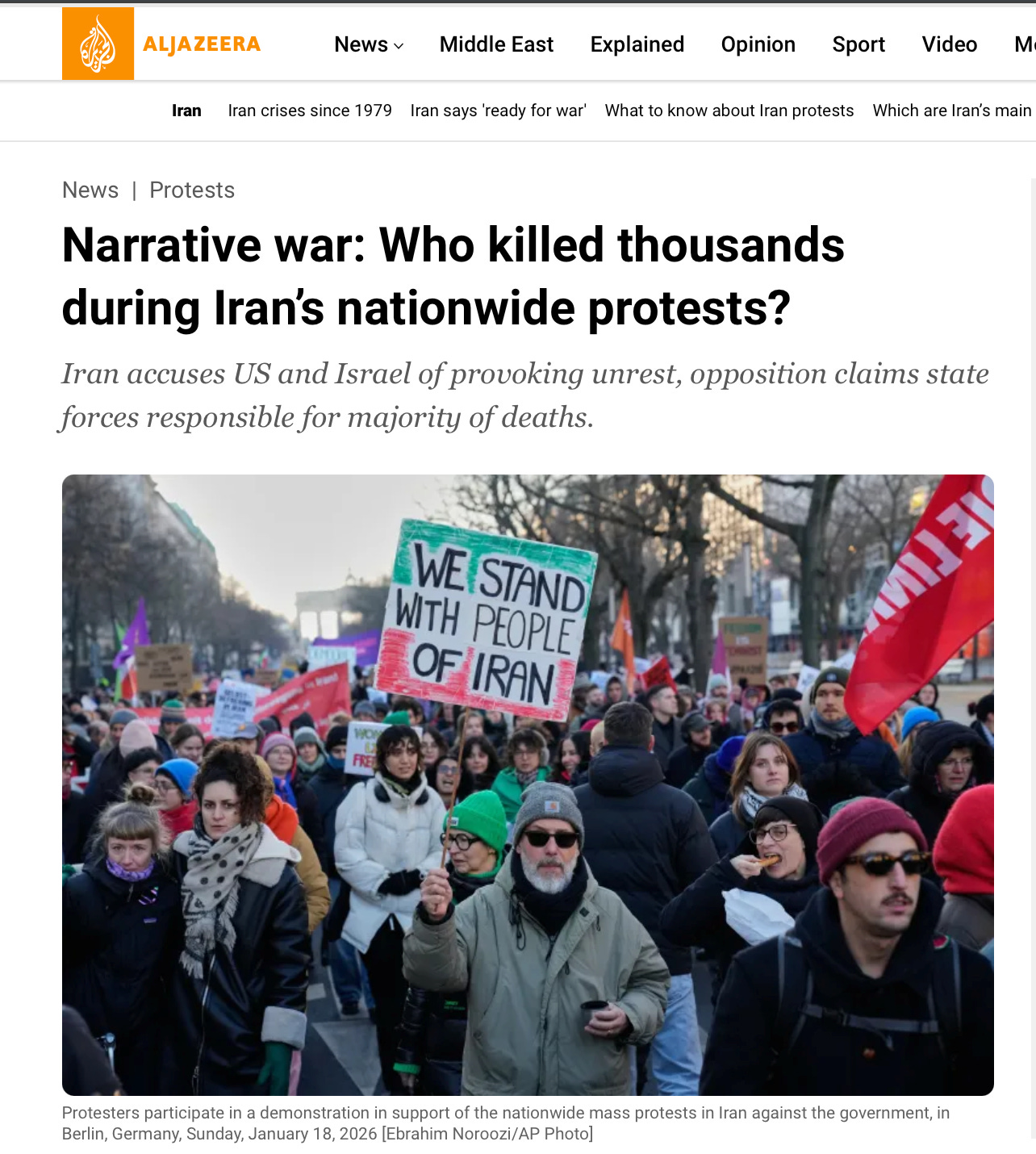
"Narrative war: Who killed thousands during Iran's nationwide protests?"; Equivocates casualties ("narrative war"); contrasts NYT verified hospital videos showing protesters shot.59
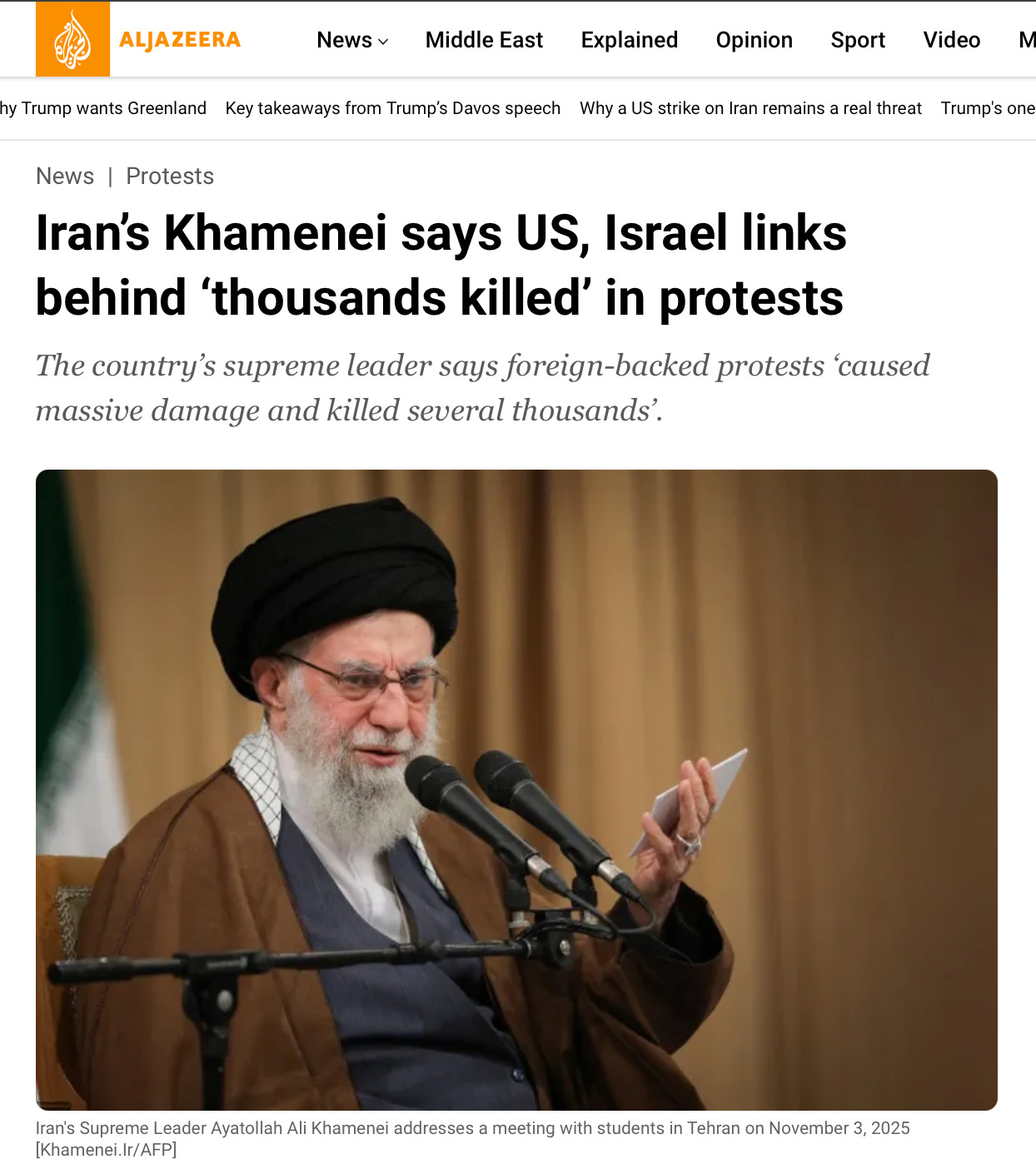
"Iran's Khamenei says US, Israel links behind 'thousands killed' in protests" – Platforms regime denial (blames "foreign agents" for deaths); Amnesty/HRW document state forces' "mass unlawful killings"60
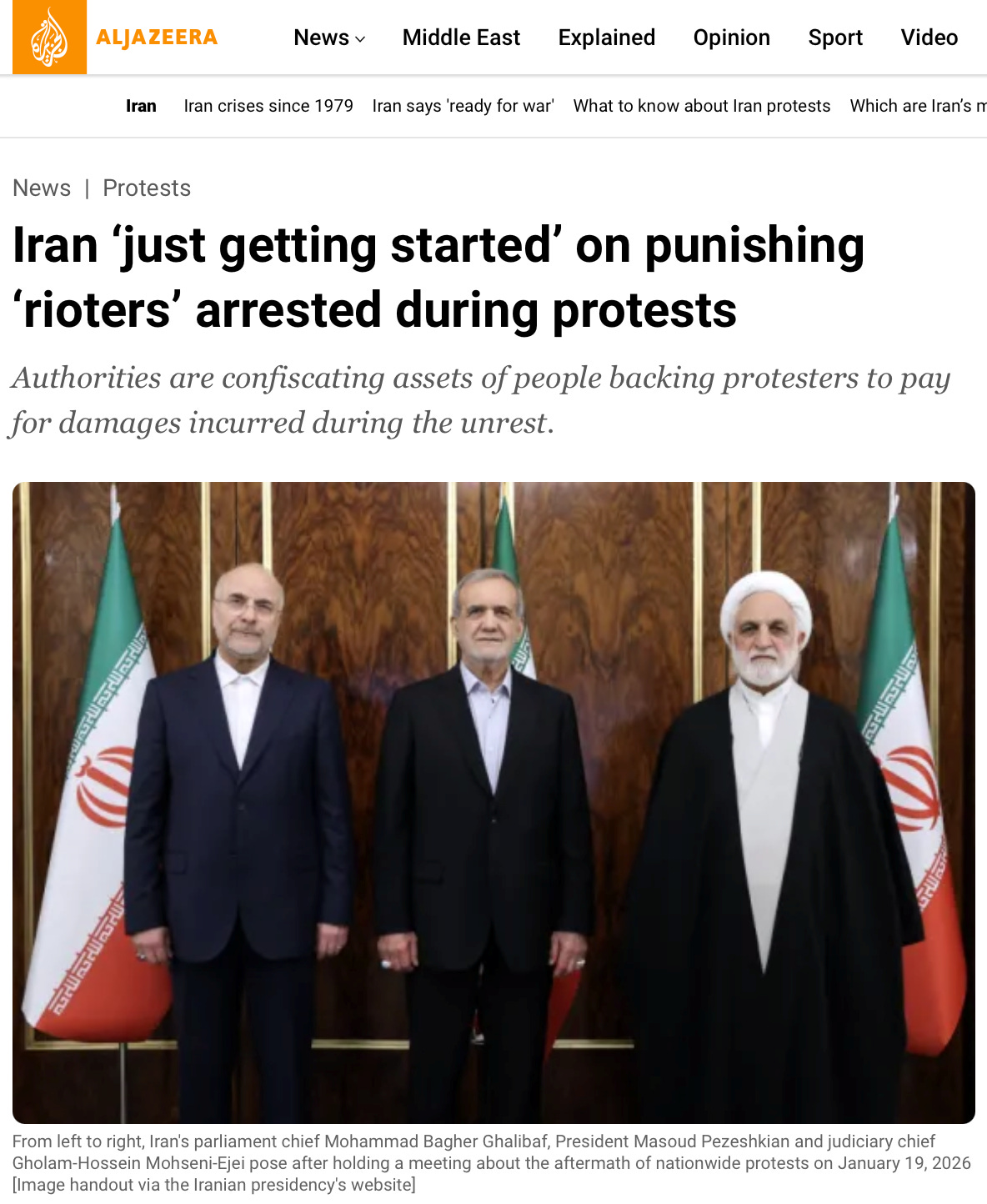
"Iran 'just getting started' on punishing 'rioters' arrested during protests." This frames protesters as "rioters" (regime term); ignores verified videos of security killings (other reports 12000 and 20000 protester deaths vs. regime's 100 security)61
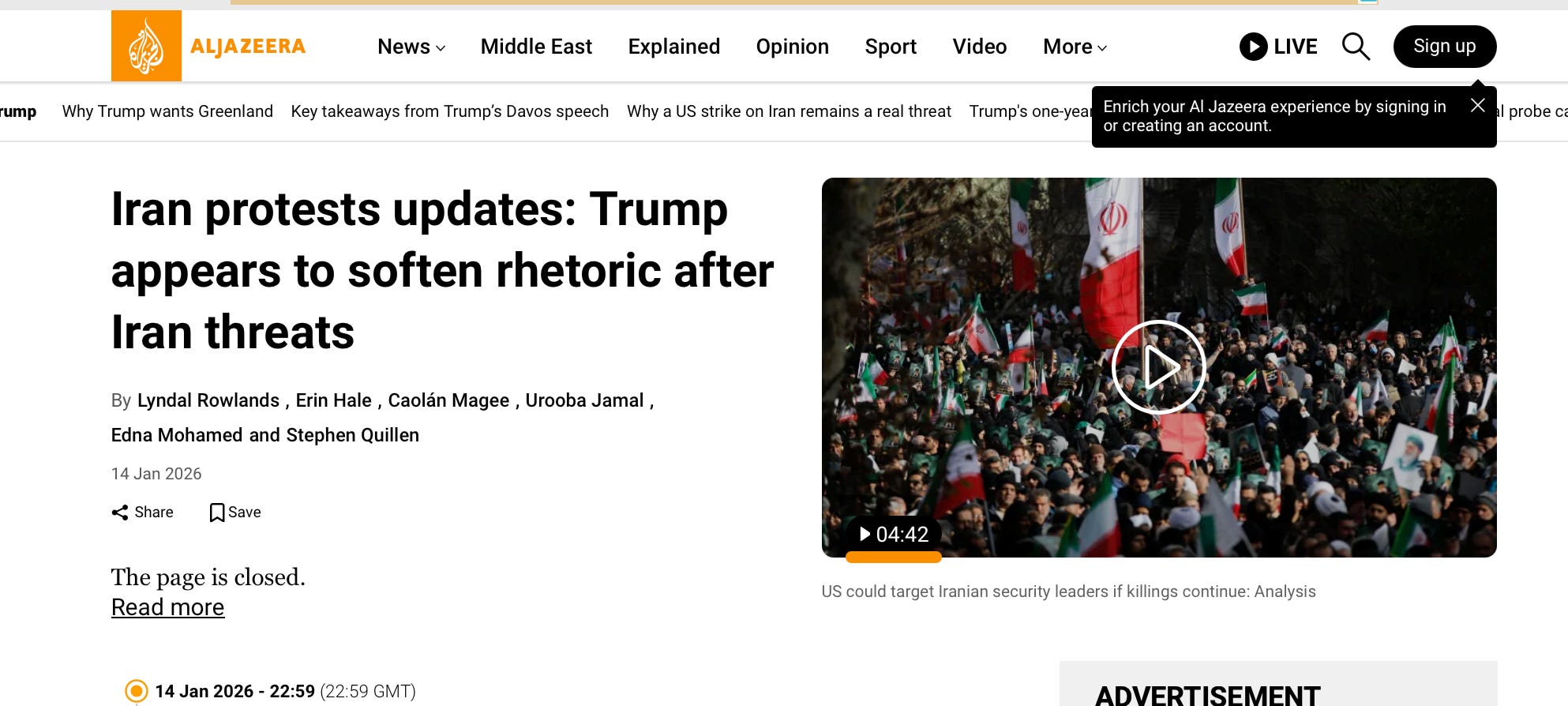
It is deliberately misleading. These headlines frame the narrative as mutual escalation when the evidence shows a one-sided dynamic: the US says "all options on the table" in response to Iran's mass killing of protesters, while Iran threatens war to deter Western support for demonstrators. Al Jazeera's "exchange of threats" framing falsely equates defensive warnings with offensive intimidation, obscuring that the US threat is conditional on Iran's continued violence against its own citizens, whereas Iran's threat is to protect its repression from external scrutiny.
A consistent pattern emerges from these headlines and news articles that may be described as follows:
Relies on state and semi-official sources for casualty framing and “martyrs” among security forces, in a blackout where independent numbers are hardest to obtain.
Casts suspicion on diaspora/external documentation efforts (including those that CBS and Iran International draw on) as part of a foreign network.
“Under a total or near-total blackout, official numbers and Al Jazeera’s state-centered casualty framing are structurally unreliable; they foreground killed officials and ‘terrorists’ using regime-linked sources.”
“CBS and Iran International are doing transparent, triangulated verification with hospital staff, morgue videos, insider leaks, and independent rights-group baselines.”
Academics, Analysts, writers in Diaspora Pushing Regime Narrative
Ali Dabashi, Professor of Iranian Studies, Columbia University:
January 2026: Told Al Jazeera the uprising is “Israel instigated” with Mossad agents among demonstrators.62
Granted academic legitimacy to the regime’s narrative that the opposition is externally orchestrated and inauthentic.
Context: Dabashi’s record includes statements equating Israel to ISIS and antisemitic comments (Columbia institutional review).
Illustrates how elite academic positions shape international policy discourse.
A segment of Western leftist intellectuals advocated “reform from within” the Islamic Republic despite the system’s demonstrated incapacity for change.
These voices “dominated academic circles and framed policy assumptions,” marginalizing other progressive perspectives.
This serves regime interests by making legitimate opposition appear compromised by foreign manipulation; the evidence that protests are legitimate says otherwise.
Trita Parsi, Iranian-born Swedish lobbyist, writer, analyst, and member of NIAC, known as the IR lobby group in the US
The Atlantic (2009): Court-released emails show Parsi coordinating with Iran’s UN ambassador Javad Zarif; law enforcement experts found evidence of undeclared lobbying violating.63
Courthouse News (2012 ruling): Judge denied NIAC’s defamation claim against “Iran lobby” label; emails showed unreported coordination with regime.64
Promoting “reform within the system” over regime change: Parsi claims protesters should work with IR insiders, rejected by diaspora/protesters as legitimizing oppression.65
Parsi says protests “started peacefully” but became “more violent”; blames sanctions for weakening opposition.66
TMR YouTube (Jan 13): Protests “have died down” after economic demands met; tests if they’ll restart Friday.67
As of January 21, 168 protests in 73 cities around the world took place by the Iranian diaspora that delivered the uprising message worldwide.68 On LinkedIn, Parsi describes these unified efforts as “ugly” and “frankly embarrassing.” He continues to frame these massive protests as a site for “using violence against each other.”69
To provide an anecdotal reference, 2013: 1$~30,000 Rial; 2026: 1$~1,480,000 → an income of ~$1,000 per month in 2013 dropped to to ~$200 per month; respectively the prices of goods increased according to their dollar value
https://www.wsj.com/world/middle-east/internet-blackout-hits-iran-as-former-shahs-son-calls-for-protests-0449c3bb
A European diplomat, cited by Iran International, stated that intelligence estimates indicate that at least 5 million people participated in nationwide protests across Iran on January 8 and 9, 2026. See https://www.iranintl.com/en/202601151368.
See report by NetBlocks on this https://netblocks.org.
https://www.iranintl.com/en/202601255198
https://time.com/7357635/more-than-30000-killed-in-iran-say-senior-officials/
https://www.iranintl.com/en/202601130145
https://www.iranintl.com/en/202601234575
https://www.iranintl.com/en/202601255198
https://time.com/7357635/more-than-30000-killed-in-iran-say-senior-officials/
https://time.com/7345347/iran-protests-death-toll-estimate-thousands/
https://www.washingtonpost.com/investigations/2026/01/14/iran-protests-videos-government-crackdown/
https://www.iranintl.com/en/202601195295
https://www.pezhvakeiran.com/maghaleh-42701.html
https://www.hrw.org/report/2010/02/11/islamic-republic-31/post-election-abuses-show-serious-human-rights-crisis
For Iran’s population, see https://www.worldometers.info/world-population/iran-population/; for natural resources, see https://en.wikipedia.org/wiki/Economy_of_Iran, https://en.wikipedia.org/wiki/Mining_in_Iran and https://www.eia.gov/international/content/analysis/countries_long/Iran/pdf/Iran%20CAB%202024.pdf.
This is not to claim that every one sees Reza Pahlavi as the transition leader of the opposition, no other name is being called upon and there has been no sign of disagreement amongst the protesters in Iran. Shah (or king) is not limited to a single person or a monarch and is historically the symbol of unity in Iran. Reza Pahlavi, the exiled crown prince of Iran, has massive popularity and is chosen as the transition leader. People chanting his name in the streets sends two messages: that the people in Iran no longer want the current regime, and that they have chosen him as the leader for the transition period. See https://foreignpolicy.com/2026/help01/16/iran-crown-prince-reza-pahlavi-protests/.
https://www.washingtonpost.com/ripple/2026/01/05/iran-protests-islamic-republic-regime-change/
For report on Iran’s underpriced oil, see https://www.reuters.com/is business/energy/chinas-heavy-reliance-iranis ian-oil-imports-2026-01-13/; for report on Rial at its all-time low, see https://www.iranintl.com/en/202512153499
For unemployment crisis, see https://irannewsupdate.com/news/economy/irans-statistical-illusion-41-million-economically-inactive-expose-hidden-unemployment-crisis/; for brain drain crisis, see https://iranfocus.com/economy/54492-irans-brain-drain-crisis-how-corruption-and-repression-are-driving-a-generation-away/.
https://mecouncil.org/blog_posts/islamic-republics-existential-crisis/
https://apnews.com/article/iran-protests-trump-khamenei-fc11b1082fb75fca02205f668c822751 reports “Iran has returned to an uneasy calm after harsh repression of protests that began Dec. 28 over Iran’s ailing economy.”
https://tribune.com.pk/story/2587486/iran-protests-abate-after-deadly-crackdown-residents-and-rights-group-say?utm_source=chatgpt.com reports, “The state-owned Press TVcitedIran’s police chief as saying calm had been restored across the country.”
For an example of report on casualties among regime forces, see https://www.aljazeera.com/news/2026/1/11/iran-says-dozens-of-officers-killed-as-protesters-defy-government-crackdown
https://www.aljazeera.com/features/2026/1/15/network-linked-to-israel-pushes-to-shape-external-iran-protest-narrative
https://countercurrents.org/2026/01/why-the-us-must-absolutely-not-force-regime-change-in-iran/
https://www.middleeasteye.net/opinion/how-israel-and-us-are-exploiting-iranian-protests
https://www.leftcom.org/en/articles/2026-01-11/dispatches-from-the-uprising-in-iran
https://www.aljazeera.com/news/2026/1/19/narrative-war-who-killed-thousands-during-irans-nationwide-protests
https://www.aljazeera.com/news/2026/1/17/irans-khamenei-says-us-israel-links-behind-thousands-killed-in-protests
https://www.aljazeera.com/news/2026/1/20/iran-just-getting-started-on-punishing-rioters-arrested-during-protests
https://www.facebook.com/aljazeera/videos/1210833703756181/
https://www.iranintl.com/en/202601211223
https://www.linkedin.com/posts/tritaparsi_ugly-and-frankly-embarrassing-scenes-activity-7419849709747609600-CNFf